Dear (sheep) farmers,
The recent Bluetongue outbreak has had a significant impact on our flock's health. Although it seems that hopefully there are less new cases every week in Devon and Somerset, there is still a lot of uncertainty regarding recovery times and fertility of the rams.
It has been proven, that the Bluetongue virus is reproducing in the testicles therefore having an affinity to ram fertility.
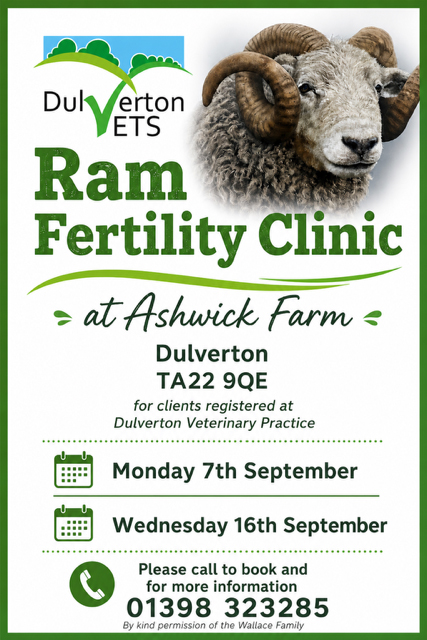
Dulverton Vets would like to offer our clients fertility clinics to enable you to obtain some insight into your ram's health and fertility and help you planning your flock's productivity before scanning the ewes in a few month's time.
We are extremely grateful to the Wallace family at Ashwick Farm and Ben Blackmore in particular to allow us to use their facilities and to host these ram fertility clinics.
There is not enough space at our premises in Dulverton, but at Ashwick we will be able to offer an efficient, cost effective, appointment only ram MOT. The animals will have a health check by a member of our staff and unless classified as unsuitable, will have a semen test on farm at the same time.
These procedures will be at a reduced price of £30.00 per ram and £20.00 for each subsenent ram.
We are recommending that the rams are running with the ewes for at least 10 days, and to be removed 2 days prior to testing.
The dates we can offer are:
Monday 07.09.2026
Wednesday 16.09.2026 (afternoon)
We might be able to offer further dates depending on demand.
We have also decided, that we will be offering free retesting, should a ram be condemned after the first test. (It has been proven that it can take up to 100 days post Bluetongue infection for the semen production to reach satisfactory levels again). The retest must be by appointment at the vets in Dulverton.
Please contact our office, if you would like to take part 01398 323285.
The team at Dulverton Vets
Bluetongue confirmed!
Look out for the signs!!!
On July 16th five new cases of BTV-3 were confirmed in England following reports of suspicious clinical signs. Since then more cases have been confirmed, at least one of them on Exmoor.
Over the last few days we have been seeing several animals with suspicious signs and after contacting the APHA we got permission to bloodtest these animals (the costs of the labortory test is covered by government funding). We are currently awaiting results.
The bluetongue virus is spread by midges. Following the recent warm weather, the temperatures became warm enough to allow for the virus to develop inside the midges, which can infect cattle, sheep and camelids when biting and sucking blood. Animals can also get infected through germinal products (semen, ova or embryos).
Sheep are more likely to show obvious clinical signs of bluetongue than cattle. Typical symptoms are:
Signs of bluetongue in cattle include:
Adult cattle may be infectious for several weeks while showing little or no sign of disease. They are often the preferred host for biting midges (the vector of bluetongue virus).
Most of the information above has been copied from the government webpage. For more detailed facts and the latest updates please take a look at gov.uk bluetongue latest updates.
We at Dulverton recommend to vaccinate all cattle and sheep. Please ring the office if you wish to learn more about available vaccinations or if you think you might have an animal with symptoms that could be related to bluetonge infection. (01398 323285)
The team at Dulverton Vets
DULVERTON PRACTICE:
Mon-Fri: 9:00AM - 5:00PM
-by appointment only-
Saturday: 9:00AM - 11:30AM
- by appointment only-
BAMPTON PRACTICE:
Tue AND Fri: 3:30PM - 4:00PM
- by appoinment only-
TELEPHONE NUMBER: 01398 323285
Mail: office@dulvertonvets.com
We can be extremely busy at times, so if we have seen your pet within the last 6 months, please ring or email us with your request and we will have it ready for you when you arrive. We would also kindly ask you to order flea and tick treatments in advance to minimise waiting times. Thank you. Tel:01398 323285
I need a prescription!